More On “Día de los Tres Reyes Magos”

Written by Lara on January 6, 2007

xx

I hadn’t realized that the day of The Three Kings was so unknown in America (at least not in the non-Latino communities)and England, both of which are the cultures from my husband’s side of the family. And so, the o.c Mom that I am, I dug up some more on the three kings to share with my husband and kids (they should know why their shoes are getting filled with candy, dont you think?, and now my blog too…. next I’ll be reporting how the big festivities went.

Los Tres Reyes Magos literally means “The Three King Wizards”, but is usually interpreted to mean “The Three Wise Men” or “The Three Kings”. Their celebration day (January 6th) is refered to as “Three Kings Day” or just “The Day of the Kings”.

In Spanish tradition, on the day of January 6th, three of the Kings: Melchor, Gaspar, and Balthazar, representing Europe, Arabia, and Africa, arrived on horse, camel and elephant, bringing respectively gold, frankincense and myrrh to the baby Jesus twelve days after his birth.

As such in Spain, this is the day that people give and receive gifts. And as children in the United States and other countries might wait with great anticipation the arrival of Santa Claus, in Spain the children await the arrival of the Three Kings.

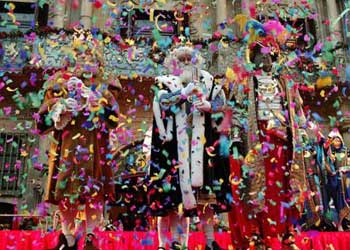
On January 5th in most Spanish towns is the “la cabalgata” (the calvacade) which is a parade marking the arrival of the Three Kings. The Three Kings ride on floats throwing candy to the children. In the Canary and Balaeric Islands the Three Kings arrive by ship!

After the parade the children return to their homes to prepare for the arrival of the Three Kings. They place their shoes on the windowsills and fill them with straw, carrots and barley for the donkeys of the Three Kings. Sometimes they might also leave some food for the Three Kings. The next morning the children wake up early to open their presents. Although the children like all of the Three Kings, their favorite is Baltasar because he is the one who it is believed actually leaves the gifts. This is also the day that adults will get their presents although of course these are not delivered by the Three Kings.

And for my history-buff husband, heres what I’ll be telling him about the Feast of the Epiphany:

Epiphany (Greek: ?????????, “the appearance; miraculous phenomenon”) is a Christian feast intended to celebrate the ’shining forth’ or revelation of God to mankind in human form, in the person of Jesus. The observance had its origins in the eastern Christian churches, and included the birth of Jesus; the visit of the Magi, or Wise Men (traditionally named Gaspar, Melchior and Balthasar) who arrived in Bethlehem; and all of Jesus’ childhood events, up to his baptism in the Jordan by John the Baptist. The date of the feast was fixed on January 6. Ancient Liturgies speak of Illuminatio, Manifestatio, Declaratio (Lighting, Manifestation, Declaration); cf. St. Matthew’s Gospel (iii, 13–17); St. Luke’s (iii, 22); and St. John’s (ii, 1–11); where the Baptism and Marriage at Cana are dwelt upon. The Christian Churches have traditionally also talked of a “Revelation to the Gentiles”, where the term Gentile meant all non-Jewish peoples. The Biblical Magi represent the non-Jewish peoples of the world.

[tags]three kings, epiphany, magi, holidays, latin[/tags]

Comments Off

The Feast of The Three Kings

Written by Lara on January 4, 2007

dd

Growing up, my family always celebrated the three kings day, or the Epiphany. We knew it as the day the three kings (also known as the Magi) would be passing our home, traveling back from Bethlehem, and if we were good and left our shoes by the window, they would fill it with candy.

Aside from that though, it really marked the end of the holiday season, as the day after we would start packing away the Christmas tree, lights and all the decorations. Since we’ve had kids, its become another holiday passed down for our kids to remember, and this year, we’ve even been invited to a three kings party at the local Spanish club. Apparently in Spain, the three kings day (which actually falls on January 6th) is a pretty big deal. Heres how they celebrate it there:

” While most of the world has already begun packing up the Christmas ornaments, throwing out the tree, and finding a place for all of their gifts, Spaniards are continuing the celebration. January 6, Three King’s Day, is the long awaited day in which the three Kings bring their gifts. On January 5, children go to a parade where they see the three kings arrive to their city, and take the opportunity to ask them for gifts. Later, before going to bed, children leave their shoes out in a visible spot in the house or on their balcony, y go to bed hoping that when they wake up they will find gifts left by Mechior, Gaspar, and Balthasar. For breakfast or after lunch, families often have the typical dessert of the day, the “Roscón de los Reyes”, a large ring shaped cake that is decorated with candied fruits, symbolic of the emeralds and rubies that adorned the robes of the three kings. Somewhere inside the cake there is a surprise, and the person to find it will be crowned King or Queen of the house for the remainder of the day. ”

[tags]three kings, epiphany, Spain[/tags]

Comments Off

Boxing Day Bits and Bobs

Written by Lara on December 29, 2006

ff

My family is a multi-cultural one. Between my husband’s family heritage and mine, much of Europe, America and Asia is covered, making it an interesting place to grow-up for our children who have a variety of world holidays to discover.

One of these is Boxing Day, which is not known to those who live away from the “Commonwealth Countries”, and is often mistakenly assumed to have something to do with the Mike Tyson kind of boxing!

So here, for all your information:

Despite its name, Boxing Day, which is celebrated on December 26 in Great Britain, has nothing to do with pugilistic competition. Nor is it a day for people to return unwanted Christmas presents. While the exact origins of the holiday are obscure, it is likely that Boxing Day began in England during the Middle Ages.

Some historians say the holiday developed because servants were required to work on Christmas Day, but took the following day off. As servants prepared to leave to visit their families, their employers would present them with gift boxes.

Another theory is that the boxes placed in churches where parishioners deposited coins for the poor were opened and the contents distributed on December 26, which is also the Feast of St. Stephen.

As time went by, Boxing Day gift giving expanded to include those who had rendered a service during the previous year. This tradition survives today as people give presents to tradesmen, mail carriers, doormen, porters, and others who have helped them.

Boxing Day is December 26, the day after Christmas, and is celebrated in Great Britain and in most areas settled by the English (the U.S. is the major exception), including Canada, Australia, and New Zealand.

Boxing Day is just one of the British bank holidays recognized since 1871 that are observed by banks, government offices, and the post office. The others include Christmas, Good Friday, Easter, Whitmonday (the day after Pentecost), and the banking holiday on the first Monday in August.

The Feast of St. Stephen also takes place on December 26. St. Stephen was one of the seven original deacons of the Christian Church who were ordained by the Apostles to care for widows and the poor. For the success of his preaching and his devotion to Christ, St. Stephen was stoned to death by a mob. As he died, he begged God not to punish his killers.

[tags]Christmas, Holidays, Christmas dinner, Christmas Story[/tags]

Comments Off
Categories: History, Holidays

What Was On The Tube (Growing Up)

Written by Lara on November 24, 2006

dd

Now that I’ve let the shameful cat out of the bag that my kids love the tube (not the London Underground, although they’ll probably go for that too), I can now blog more freely about this overly-demonised activity (or inactivity rather).

When I was young, my Mother never stopped my sister and I from watching television. There were no house rules as to which programs we could see (obviously porn and the disturbingly violent were not in the picture, but we didnt want to see them anyway), and there were no “tv” time limits or specifics to regulate it at all.

In fact, when I was around two and Sesame Street first came out, my Mom proudly told me that I’d watch it every day, at eleven o’clock sharp, while I ate my brown rice and fried chicken with a Japanese sesame topping she made from scratch (we were into the micobiotic diet thing and she practiced trancendental meditation if you get my drift).

Years later, my sister and I would get home after grade school and head straight for the television, where we’d watch cartoons from Superfriends to Smurfs while having our after-school snack. Not that we were couch potatoes by a mile. In fact, while the television was a device open to us to our hearts content, we nearly always preferred to play with each other - whether it was our elaborate imaginary games under the big dining room table, in the sunken living room (it was the late seventies!!), or in our room, where we would lay out all our play houses and entertain ourselves for hours with a game we called “village”.

[tags]Seventies television, childhood, television, Sesame Street[/tags]

Comments Off
Categories: Growing Up, History, Home, Moms

ADHD: The Basics

Written by Lara on October 5, 2006

ss

As a follow up on my post some days ago about ADHD Paranoia, I did some research on ADHD, and to be honest, am still non the wiser on whether my paranoia had some basis or not. What I do know is that I do have a daughter who is decidedly a handful (having a tantrum now as I type this over not having TV control because Daddy wanted to watch his sports), and the only way to really find out is through a battery of tests given my a psychiatrist.

So here’s what I dug up:

What is ADHD? Attention Deficit Hyper Activity Disorder. In the old days they used to just say things like “Oh, Jamie is hyper”, but I guess now the norm is more like” oh, Jamie has ADD and takes medication”.

Doctors explain though that the difference between old fashioned hyperactivity which most small kids have, is that kids with ADD have the symptoms for a prolonged period of time and it adversely affects their functions at home, ss and in social situations. Its frighteningly become a “common” disorder, said to affect 8-10% of school children.

But where is the line drawn between normal naughty kid behaviour and a medical disorder? Unfortunately, like I said earlier, its a call only a trained professional can make.

[tags]ADHD,ADD,Kids,Health[/tags]

Comments Off

Reading Nostalgia: All-Of-A-Kind Family

Written by Lara on August 29, 2006

ddd

As we got a little older, my sister and I became voracious readers. One of our favourite places in the world was the Foyles bookshop in London, where we would spend hours on end choosing and reading books. The library near the Edgware Road was also a weekly treat. After a whole afternoon choosing books, we would pass by the local bakery for some delicious “air” bread to take home for tea. It truly was the stuff of childhood memories!

Anyway, the all-of-a-kind family was another series we re-read over and over again. For two girls growing up in the late seventies, there was a strange fascination with this turn-of-the-century family in America. Who can resist the characters - sensible Ella, the eldest girl, spunky Henny with her perfect curls, the little sisters and of course Mama and Papa who had very little money but a lot of morals- and love!

Written by Sydney Taylor, The all-of-a-kind family comprised 5 sisters (who were Jewish), growing up in New York’s Lower East Side. Simple joys, simple activities, ah the simple life in those days!

All-of-a-Kind Family (1951) is the first book of a series. Other books in the series include
More All-of-a-Kind Family (1954), All-of-a-Kind Family Uptown (1957), All-of-a-Kind Family Down-town (1972), and Ella of All-of-a-Kind Family (1978).

My copies all seem to be gone now (Mom! where have they gone?), but I can’t wait until the day I can introduce them to my daughter.

Comments Off
Categories: Books, History, Moms, Shopping

Reading Nostalgia: Babar

Written by Lara on August 27, 2006

ddd

Another favourite book of my sister and I growing up were of Babar the elephant who lived with his tres charmant famille in Celesteville. On our first trip to Paris, my sister had a rather large stuffed toy of him which she took to the top of the Eiffel tower, just like in the story - needless to say it was the highlight of our trip and a very fond memory for both of us.

Here are some Babar facts:

With over 100 licensees worldwide, the Babar brand has a multi-generational following. There are even 12 dedicated Babar stores in Japan.

Babar has eight points to his crown.

A global cultural phenomenon, whose fans span generations, Babar stands along side Mickey as one of the most recognized children’s characters in the world.

Babar made his debut in “The Story of Babar” published in 1931 by Jean de Brunhoff. Jean created and illustrated seven Babar titles before dying in 1937. Laurent de Brunhoff, son of Jean, continues his father’s work and is still writing Babar books.

In 2006 Babar will celebrate being King of The Elephants for 75 years.

There are now over 30,000 Babar publications in over 17 languages, and over 8 million books have been sold. Laurent de Brunhoff’s Babar’s Yoga for Elephants is a top seller in the U.S with over 100,000 copies sold to date. The Babar series of books are recommended reading on First Lady Laura Bush’s national reading initiative list. Babar has been a perennial favorite for years at the White House Easter Egg Roll.

Comments Off

Mother: The Definition

Written by Lara on August 13, 2006

ddd

Yes, it is the word that defines so many of us women – and it is much much more than our job description or family role. As we all know it’s the most maddening yet fulfilling job in the world. But what is the real definition of the word according to the academics? In case you’re curious….

In the case of a mammal such as a human, the biological mother gestates her child (called first an embryo, then a fetus) in the womb from conception until the fetus is sufficiently well-developed to be born. The mother then goes into labour and gives birth. Once the child is born, the mother produces milk to feed the child.

In non-sexual organisms, “mother” can sometimes be used to mean “parent”; in the case of single-celled organisms that reproduce by fission, the mother is a cell that divides to produce “daughters”.

Mothers typically have a very important role in raising children, and the title mother can be given to a woman other than a biological parent who fills this role. This is most commonly either an adoptive parent or a stepmother (the wife of a child’s father). The term can also refer to a person with stereotypical traits of a mother.

“Mum”/”mummy”, “Mom”/”mommy”, “mama” and “ma” are some familiar or colloquial words for a mother. In many south Asian cultures, the mother is known as “Amma” or “Oma” or “Ammi”, or variations thereof. The “M” sound seems to be universal to the word mother in many different languages. Many times these terms denote affection or a maternal role in a child’s life.

In some societies, single motherhood, the state of an unmarried mother, has been treated as a serious social issue.

Comments Off
Categories: History, Moms

Making A Family Time Capsule

Written by Lara on July 1, 2006

dd

Your child is growing so quickly. You are amazed at her every move, her adorable smiles and her ever-growing personality. Why not capture these moments so she can enjoy her childhood long into adulthood? Creating a family time capsule is a wonderful way to protect those cherished memories and strengthen your family’s bond.

If you plan on burying your time capsule outdoors, you will need a waterproof container: a plastic tub with a lid or a large jar works well. You may also use an old lunch box, or a cardboard box sealed in a knotted plastic bag.

Now you can add individual lists of “Things I Am Good At,” as well as school papers, drawings and one special toy apiece. Your child can write a letter to himself, outline feet and hands or describe dreams, ideas and favorite pastimes. Height and weight measurements can also be included for comparison when you dig up the capsule.

Seal your treasures in a plastic bag, and place in the container. Bury the capsule in a secret place, or hide it in the house, garage or attic. You and your family can decide when your capsule should be retrieved. Given a child’s rate of development, even a few months may be long enough.

Comments Off
Categories: Crafts, History

The Origins Of Father’s Day

Written by Lara on June 13, 2006

dd

Fathers hold a special place in a child’s life. Some Fathers are involved with sports teams, outdoor games, and having lots of fun. While other Dads enjoy helping children learn new skills. It could be anything from baking to building bird houses. It really doesn’t matter how Dads spend time with their children, as long as they do spend time together. Father’s Day is a time to remember just how special is your Dad.

There are many stories how the custom of honoring Dads on a Sunday in June got started. The most popular story about the origins of Father’s Day is said to have started growing its roots in the year of 1909. Mrs. John B. Dodds, from Spokane, Washington, campaigned for a Father’s Day celebration. The idea came to her while she listed to a church sermon on the virtues of Mother’s Day.

Mrs. Dodds thought about her own childhood, raised in a family of six children by a single father after the death of her mother. Mrs. Dodds thought of her father, who acted as both father and mother, and nurtured and cared for her and her siblings. There were many other fathers who selflessly gave of themselves to help take care of their own children, as well as provide for them financially too.

She wanted all fathers to be honored with a special day all their own. She campaigned and worked to spread her message, and even got the help of friends and family to write letters to influential people who could make this dream happen for her.

After much hard work, Father’s Day was first celebrated in 1910. Mrs. Dodds wanted the date of the holiday to be on her father’s birthday, which was the fifth of June. But the events had to be moved to the nineteenth of June so there would be enough time to prepare.

Over time, annual celebrations were held throughout the United States and Canada. In 1972 Richard M. Nixon signed a congressional resolution creating Father’s Day in the United States.

Today, this special day provides the opportunity to honor fathers, stepfathers, uncles, grandfathers, guys that act as big brothers, and any other men that have played the father role model your life.

Comments Off
Categories: Dads, History, News